The Definitive Landscape
96 Vendors Across 10 Categories
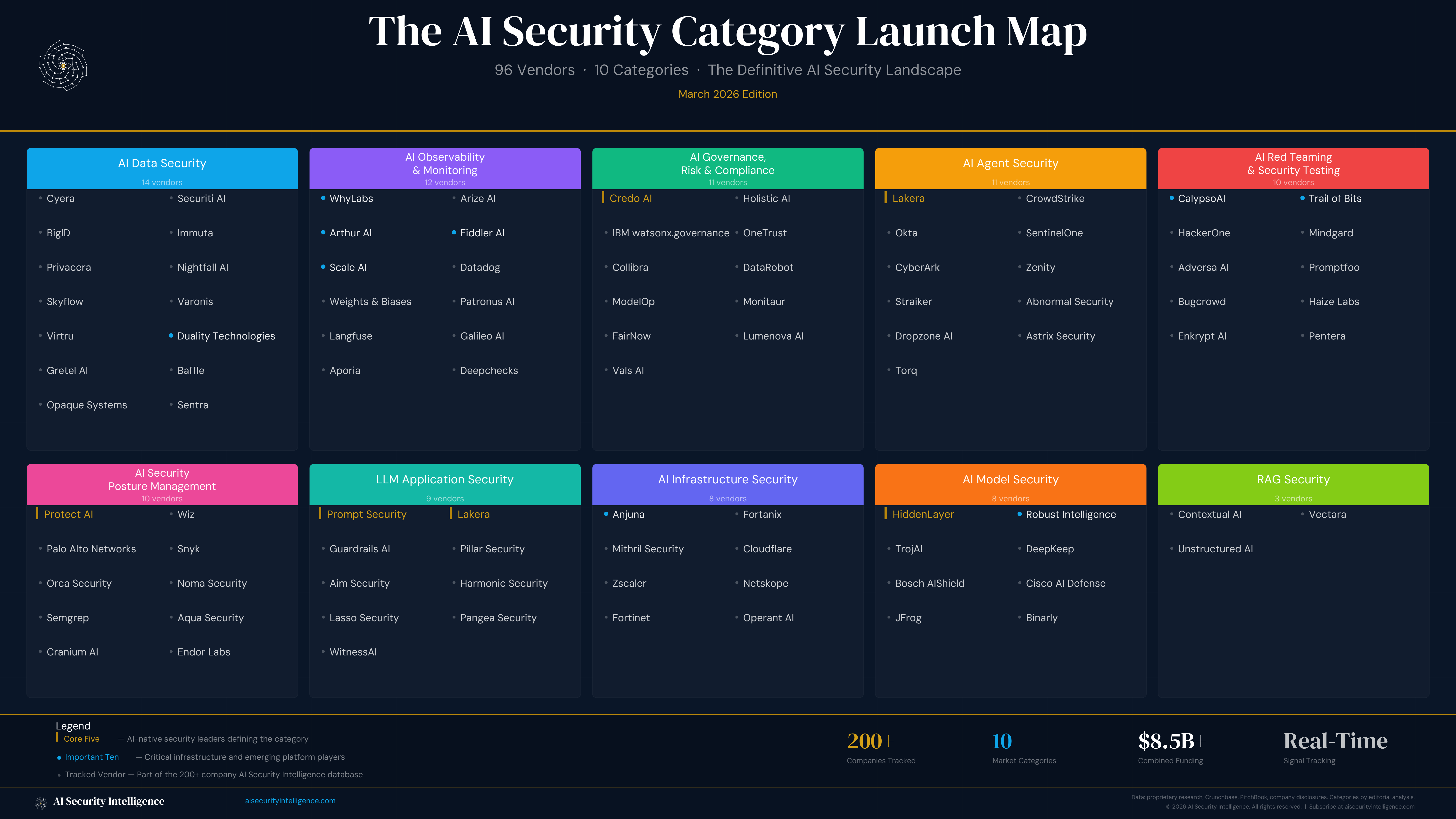
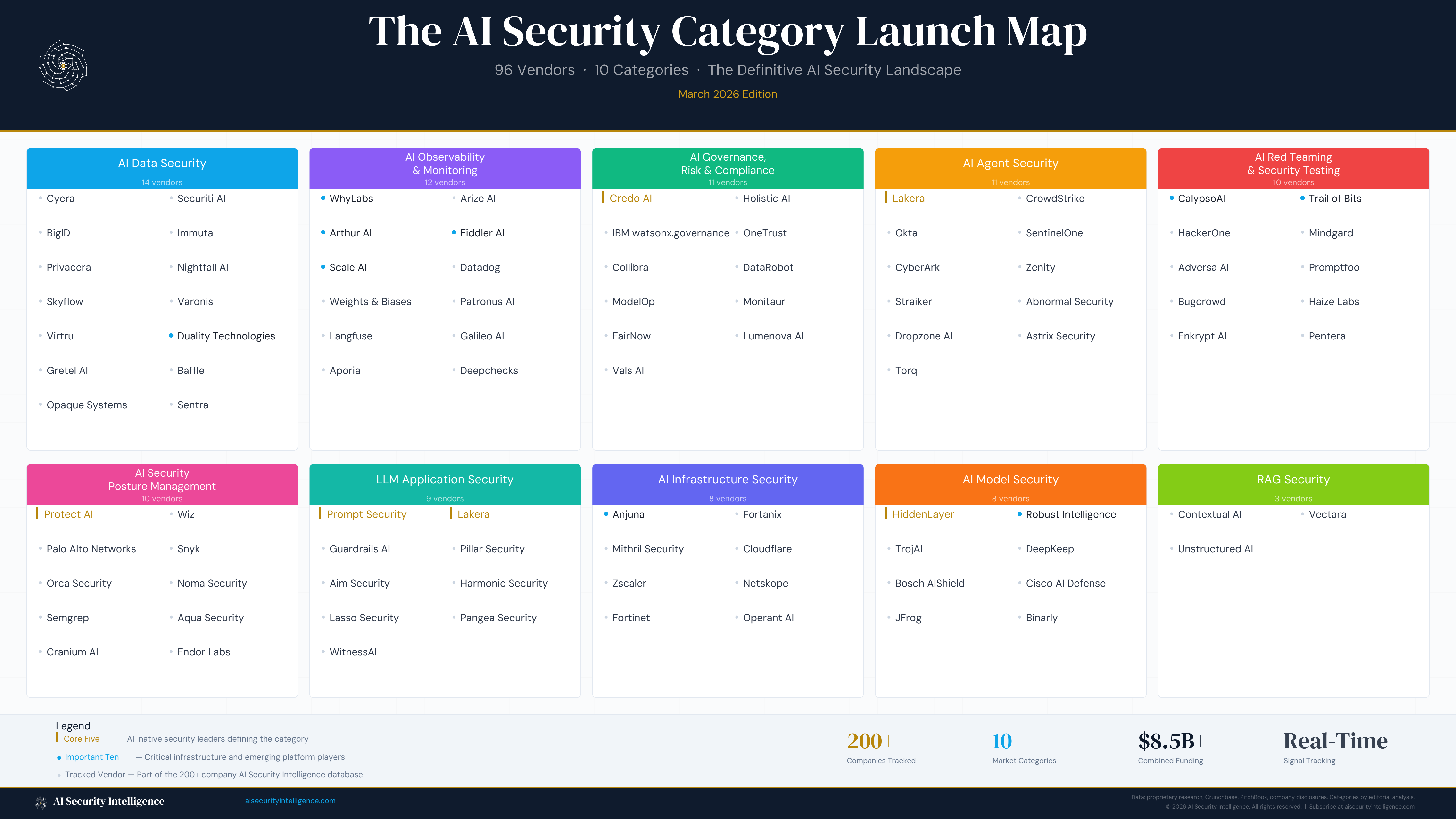
Two variants of the same definitive map — dark for presentation and digital use, white for print and documentation.
Market Intelligence Report · March 2026
96 vendors. 10 categories. The first definitive mapping of the AI security landscape.
AI security has crossed a critical threshold — evolving from a collection of fragmented point solutions into a definitive, investable market category. This map charts the entire landscape.
No single source has mapped the full breadth of the AI security market — until now. The Category Launch Map is the product of proprietary research tracking over 200 companies, analyzing funding rounds, M&A activity, product capabilities, and competitive positioning across 10 distinct categories. What emerges is a landscape that is broader, deeper, and more commercially mature than most industry observers realize.
This report is designed for four audiences: enterprise CISOs navigating AI security procurement decisions, defense and government leaders building secure AI infrastructure, investors evaluating category dynamics and exit potential, and the vendors themselves — seeking to understand where they sit and who they compete against. The map is a living document. It will be updated quarterly as the market evolves.
Two variants of the same definitive map — dark for presentation and digital use, white for print and documentation.
Each category represents a distinct capability domain within the AI security ecosystem. Tap any category to explore the vendors shaping it.
Protecting training data, model inputs, and outputs. Encompasses data classification, access governance, encryption, privacy-preserving computation, and synthetic data generation for AI pipelines.
Runtime visibility into model behavior, drift detection, performance degradation, and anomaly identification. Critical for production ML systems operating at scale.
Policy enforcement, regulatory alignment (EU AI Act, NIST AI RMF), bias auditing, and organizational risk management for AI deployments across regulated industries.
Securing autonomous AI agents, tool-calling LLMs, and agentic workflows. Addresses identity, authorization, prompt injection defense, and behavioral guardrails for AI systems that take actions.
Adversarial testing, model probing, jailbreak detection, and vulnerability assessment. Combines automated scanning with human-in-the-loop red team exercises.
Continuous discovery and risk assessment of AI/ML assets across the enterprise. Maps model inventories, identifies misconfigurations, and tracks supply chain dependencies.
Guardrails, content filtering, prompt injection defense, and output validation for applications built on large language models. The fastest-growing category by vendor count.
Securing the compute, networking, and hardware layer powering AI workloads. Confidential computing, TEEs, model serving protection, and cloud-native AI security.
Protecting model weights, architectures, and intellectual property from theft, tampering, and adversarial manipulation. Includes model watermarking and supply chain integrity.
Emerging category focused on securing retrieval-augmented generation pipelines. Addresses knowledge base poisoning, context window manipulation, and grounding verification.
Two tiers of market-defining companies — the Core Five shaping category boundaries, and the Important Ten building critical infrastructure beneath.
Five AI-native security companies that are defining the category. Each approaches AI security from a different vector, collectively covering the critical surface area.
Critical infrastructure players and emerging platforms whose work underpins the broader AI security ecosystem.
Eight major acquisitions in 2025–2026 with over $2B deployed by platform vendors. The window for independent AI security startups is narrowing as legacy cybersecurity giants move aggressively into the category.
8 M&A deals · $2B+ deployedThe fastest-growing attack surface in enterprise AI. As autonomous agents gain tool-calling capabilities and take real-world actions, securing agentic workflows has become the top CISO priority for 2026.
11 vendors · Fastest-growing categoryThe EU AI Act and NIST AI Risk Management Framework are transforming AI governance from a nice-to-have into a regulatory mandate. Every enterprise deploying AI now needs an auditable compliance posture.
EU AI Act · NIST AI RMFA clear split is emerging between pure-play AI security vendors building purpose-built platforms and legacy cybersecurity companies bolting on AI capabilities. The pure-plays are winning on depth; incumbents are winning on distribution.
Pure-play vs. bolt-onMassive capital deployment across the 96 mapped vendors signals long-term institutional conviction. AI security is no longer a niche — it is a category that the market's largest allocators are treating as foundational infrastructure.
$8.5B+ raised across 96 vendorsThe Category Launch Map is built on proprietary research and continuous market tracking. Here is how the data was assembled.
Continuous monitoring of 200+ companies across the AI security ecosystem, including stealth-stage startups and enterprise incumbents expanding into AI.
Funding and M&A data from Crunchbase and PitchBook, supplemented by company disclosures, SEC filings, press releases, and product documentation analysis.
Categories defined through editorial analysis of product capability, market positioning, competitive dynamics, and buyer intent — not self-reported vendor classifications.
The map is a living document, updated quarterly to reflect new entrants, exits, M&A activity, and category boundary shifts as the market evolves.
Stay Informed
Subscribe to the AI Security Intelligence Weekly Briefing for market signals, M&A tracking, and threat landscape analysis.
Free weekly intelligence. Unsubscribe anytime. No spam, no data sharing.